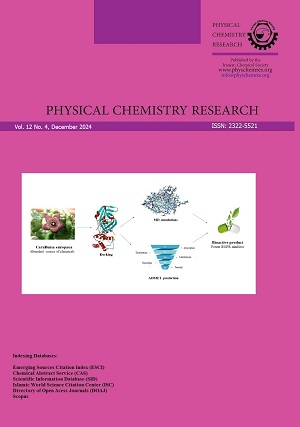
Evaluation of Designed Peptide Inhibitors in Destabilization of Aβ42 Protofibrils: A Molecular Dynamics Study

Document Type : Regular Article

Authors

Department of Chemistry, K. N. Toosi University of Technology, P. O. Box: 15875-4416, Tehran, Iran

Abstract
The development of Alzheimer's disease (AD), the most prevalent form of dementia, is associated with the abnormal aggregation of Amyloid-β (Aβ) peptides into fibrils and plaques, leading to a decline in brain function. A promising approach to treating Aβ pathology involves inhibiting fibrillogenesis and developing compounds that effectively disrupt the stable structure of Aβ fibrils. To investigate the destabilizing effects of peptides on Aβ42 protofibrils, we designed 42 different N-methylated peptides that bind to Aβ42 protofibrils. We then studied the protofibril-peptide interactions using molecular docking, free energy calculations, and molecular dynamics (MD) simulations. Our results demonstrate that peptides induce changes in the secondary structure of Aβ42 protofibrils, ultimately leading to the formation of a less ordered structure. Increased Root Mean Square Deviation (RMSD), reduced residue contacts, disrupted salt bridge interactions, and decreased hydrogen bonds between chains in the Aβ42 protofibril indicate destabilization of the protofibril structure. Among the peptides tested, P3 and P11, both singly N-methylated, exhibited the most potential for disrupting the Aβ42 protofibril structure.

Graphical Abstract

Evaluation of Designed Peptide Inhibitors in Destabilization of Aβ42 Protofibrils: A Molecular Dynamics Study

Keywords

Subjects


Volume 12, Issue 4 - Serial Number 44
Autumn 2024
Pages 991-1004

  • Receive Date 23 April 2024
  • Revise Date 12 July 2024
  • Accept Date 31 July 2024